Su Shi (蘇軾, 1037–1101), also known by his courtesy name Zizhan (子瞻) and his literary sobriquet Dongpo (東坡, "Eastern Slope"), is one of the most celebrated figures in the Chinese literary tradition. He lived during the Northern Song dynasty (北宋, 960–1127), a period of exceptional cultural refinement in Chinese history — an era of landscape painting, printed books, Neo-Confucian philosophy, and a civil service governed by scholar-officials who were poets, painters, and calligraphers as much as they were administrators.
- Full name
- 蘇軾 Sū Shì
- Courtesy
- 子瞻 Zǐzhān
- Sobriquet
- 東坡居士 Dōngpō Jūshì — "The Retired Scholar of the Eastern Slope," adopted during his Huangzhou exile
- Dates
- 1037–1101 CE
- Dynasty
- Northern Song (北宋), 960–1127
- Birthplace
- Meishan (眉山), present-day Sichuan Province
- Roles
- Poet, prose writer, calligrapher, painter, gastronome, engineer, political figure
Su Shi was not simply a writer. In Song-dynasty China, the ideal of the literatus (文人, wenren) demanded mastery across multiple domains: poetry, prose, calligraphy, painting, and political governance were not separate careers but facets of a single cultivated life. Su Shi excelled in all of them. He is traditionally counted among the "Eight Great Prose Masters of the Tang and Song" (唐宋八大家), and his calligraphy is regarded as among the finest of his era. His poems are still memorised by schoolchildren across East Asia today.
His political career, however, was defined by repeated conflict with the reigning factions at court. Su Shi refused to align fully with either the reformists (led by Wang Anshi, 王安石) or the conservatives. This independence made him enemies on both sides — and led, ultimately, to the crisis that produced the Red Cliff Rhapsodies.
In 1079, Su Shi was arrested on charges of slandering the emperor through his poetry — an event known as the Wutai Poetry Inquisition (烏台詩案, literally "the case of the Black Terrace," named after the censorate building where the investigation was held). Political rivals extracted phrases from his poems and reinterpreted them as veiled attacks on imperial policy. Su Shi was imprisoned in the capital Bianjing (汴京, present-day Kaifeng) for over one hundred days, during which he believed he would be executed.
He survived — narrowly — and was sentenced not to death but to exile: stripped of all official posts and banished to the remote town of Huangzhou (黃州, in present-day Hubei Province), where he was given a nominal title with no salary and no administrative duties.
For a modern reader, "exile" might suggest a change of address. In Song-dynasty China, it meant something far more severe. A scholar-official's entire identity — his income, social standing, access to the court, and right to participate in the governing class that defined an educated man's sense of self — was stripped away. Exile was not prison, but it was a form of social death: the exiled official became invisible to the political world he had spent his life inhabiting.
Crucially, exile meant severance from Bianjing (汴京, present-day Kaifeng) — the Song capital and the undisputed centre of Chinese civilisation. Bianjing was where policy was made, where literary reputations were forged, where the court and the examination system determined every scholar-official's future. To be exiled was not merely to leave a city; it was to be physically cut off from the only world in which one's education, talent, and life's work had meaning. There was no "remote work," no correspondence that could substitute for presence at court. An exiled official could write, but he could not be read by the people who mattered; he could think, but he could not act. The distance between Bianjing and Huangzhou — roughly 700 kilometres of river and mountain — was, in political terms, infinite.
Su Shi arrived in Huangzhou impoverished and disgraced. He farmed a plot of land on the "Eastern Slope" (東坡) — which gave him the sobriquet by which he is best known. It was in this condition of radical loss that he wrote the two Red Cliff Rhapsodies in the summer and autumn of 1082.
The emotional arc between the two Rhapsodies cannot be understood without this context. In the First Rhapsody (July 1082), Su Shi had been in exile for over two years and had actively cultivated philosophical detachment — studying Buddhism and Daoism, farming, writing. The text records a moment where that strategy is working: the moon endures, the river is constant, nature offers consolation that the state cannot confiscate. In the Second Rhapsody (October 1082), only three months later, the same strategy appears to have reached its limit. The landscape has turned cold and strange, the philosophical arguments are not repeated, and the text ends not with shared wine and companionable sleep but with a solitary awakening and an empty doorway. The shift from transcendence to the uncanny is not arbitrary — it is the sound of a man's coping mechanism beginning to crack under the weight of prolonged exile.
The 賦 (fù) is a Chinese literary genre with no exact Western equivalent. Usually translated as "rhapsody" (less accurately as "ode" or "prose-poem"), it combines rhythmic prose with lyrical verse, and is characterised by elaborate description, philosophical reflection, and often a dramatic dialogue structure. The genre dates back to the third century BCE, but Su Shi's Red Cliff Rhapsodies are considered among its greatest examples — and among the last major works in the form.
A defining feature of the fu is its host–guest dialogue structure (主客問答, zhǔ-kè wèndá). Since the Han dynasty (206 BCE – 220 CE), most fu have been structured as a conversation between a "host" (主人) and a "guest" (客), in which the guest raises a problem — often existential or political — and the host responds with a philosophical argument. This convention directly explains why the figure of "the Guest" appears in Su Shi's text: he is not an incidental companion but a structural requirement of the genre. The Guest voices the despair that the host must then overcome. (Whether Su Shi's Guest is a real person, a literary device, or both, remains an open scholarly question — see the Guest tab on the Five Images page.)
The fu is also a performative genre. It was originally composed for recitation at court, and its language is deliberately heightened: elaborate metaphors, extended descriptions, and rhetorical amplification are expected, not excessive. When Su Shi describes the moon "lingering between the constellations" or the wind carrying the boat "as if riding the void," he is working within a genre where such language is the norm. A reader unfamiliar with this convention might mistake the imagery for mere ornamentation; in fact, it is the genre's primary means of philosophical argument — ideas are conveyed through the accumulation and transformation of images, not through abstract propositions.
Finally, Su Shi's two Red Cliff Rhapsodies are anomalous within the fu tradition. Rhapsodies do not normally come in pairs. A single fu is a self-contained performance; writing a second one on the same subject, at the same location, three months later, is an act of deliberate self-revision. The Second Rhapsody is not a sequel but a counter-argument — a text that reopens questions the First had appeared to resolve. This pairing is what makes the Red Cliff Rhapsodies unique in Chinese literary history, and it is the structural premise of this Digital Scholarly Edition.
In the summer and autumn of 1082, Su Shi twice visited a riverside cliff near Huangzhou that he called "Red Cliff" (赤壁). Each visit produced a rhapsody. The two texts are among the most studied works in all of Chinese literature — not least because they form a rare case of authorial self-variation: the same writer revisits the same site, the same themes, and the same images, yet produces two radically different emotional responses.
To understand why "Red Cliff" (赤壁) matters, a non-Chinese reader needs to know one event: the Battle of Red Cliff (赤壁之戰, 208 CE). At the end of the Han dynasty, China fractured into rival kingdoms. The warlord Cao Cao (曹操, 155–220 CE), who had unified the north and commanded the largest army in China, sailed a massive fleet down the Yangzi River to conquer the south. At Red Cliff, the allied southern forces of Sun Quan (孫權) and Liu Bei (劉備) defeated Cao Cao using a fire attack — setting his fleet ablaze and ending his bid to reunify the empire. This defeat sealed the division of China into the Three Kingdoms (三國, 220–280 CE), one of the most mythologised periods in Chinese history.
The cultural significance of this battle is difficult to overstate. The Three Kingdoms period became the subject of China's most widely read historical novel, Romance of the Three Kingdoms (三國演義, 14th century), and its heroes — Cao Cao the cunning tyrant, Liu Bei the virtuous ruler, Zhuge Liang the brilliant strategist — remain household names across East Asia today. Red Cliff is the pivotal scene in this narrative: the moment where ambition overreaches and is destroyed. For a rough Western analogy, imagine if the Battle of Thermopylae, Waterloo, and the fall of Troy were compressed into a single event at a single identifiable location — that is approximately the cultural weight "Red Cliff" carries.
By the Song dynasty (960–1279), nearly nine centuries after the battle, Red Cliff had become a site of literary pilgrimage. Educated men (文人, wenren) would visit the site — or sites believed to be the site — to compose poems and essays reflecting on the transience of military glory. This practice, known broadly as "visiting ancient sites to mourn the past" (懷古, huáigǔ), was a major literary tradition. The visitor stands where heroes once fought and died, sees that nothing remains but river and cliff, and draws a philosophical lesson about impermanence. Su Shi's Red Cliff Rhapsodies belong to this tradition — but, as we shall see, they also subvert it.
The name "Red Cliff" (赤壁) is famous in Chinese history because of the Battle of Red Cliff (208 CE), a decisive naval engagement in which the allied forces of Sun Quan and Liu Bei defeated the northern warlord Cao Cao (曹操). This battle — one of the most celebrated in Chinese military history — is the reason Su Shi invokes Cao Cao in the First Rhapsody.
However, the cliff Su Shi visited at Huangzhou is not the actual site of the ancient battle. The historical Red Cliff is believed to be some 130 kilometres upstream. Su Shi almost certainly knew this. The "misidentification" is deliberate — it becomes the literary premise: standing at a place that merely shares the name of a famous battlefield, Su Shi meditates on how history fades and names outlast the events they once referred to. The gap between name and reality is itself part of the argument about impermanence.
前赤壁賦
Su Shi and a guest sail by moonlight on the Yangtze. The moon rises, a gentle wind blows, the water is still. The guest plays a flute and sings of mortality and the vanished heroes of Red Cliff. Su Shi responds with a philosophical argument: the river flows on yet never disappears; the moon waxes and wanes yet never truly diminishes. What seems transient is, from another perspective, eternal. The two friends drink, fall asleep in the boat, and wake at dawn.
Harmony Tension → Resolution後赤壁賦
Three months later, Su Shi returns. The landscape has changed: the water is loud, the cliff is steep and strange, the trees are bare. He climbs the cliff alone, hears the cry of a hawk, feels the wind as menacing. That night, he dreams of a Daoist priest who transforms into a crane. He wakes — and the visitor is gone. The boundary between dream and waking, human and animal, self and other, has dissolved.
Estrangement UncannyThe emotional arc across the two Rhapsodies — from philosophical transcendence to dreamlike estrangement — is this edition's central subject. Five images recur in both texts, but each one shifts in meaning and feeling:
In the First Rhapsody, the moon rises as a luminous companion; in the Second, it has retreated to a cold distance. Water transforms from a mirror of philosophical stillness to a roaring, unsettling force. The Guest shifts from a voiced interlocutor to a spectral figure who may or may not be human. The Five Images page of this edition analyses each transformation in detail.
This is a Digital Scholarly Edition (DSE): not simply a digitised text, but an edition that uses the affordances of the digital medium to do things a printed book cannot. Existing print editions of the Red Cliff Rhapsodies — such as Burton Watson's 1965 translation and Stephen Owen's 1996 anthology — present the two texts sequentially, without visual comparison, without manuscript access, and without annotation of the recurring imagery that constitutes the texts' central literary achievement.
This edition addresses that gap. It is encoded in TEI/XML (the scholarly standard for digital text encoding) and designed to make visible the relationship between the two Rhapsodies that is difficult to perceive when the texts are read in isolation.
Synoptic Reading
Both rhapsodies displayed side by side, paragraph by paragraph, so the reader can see how themes and images correspond across the two texts.
Open Texts →Image Annotation
Every occurrence of the five core images is highlighted and annotated with its emotional register, editorial commentary, and links to both Watson's and Owen's translations.
Open Five Images →Manuscript Access
The only surviving autograph manuscript of the First Rhapsody — Su Shi's own handscroll, held at the National Palace Museum, Taipei — is viewable via IIIF, at full resolution.
Open Manuscript →Translation Comparison
Two major English translations — Watson (1965) and Owen (1996) — are togglable alongside the Traditional Chinese original, allowing the reader to see how translators interpret the same passage differently.
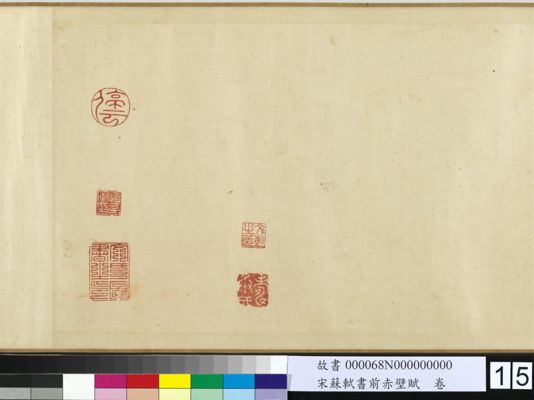
宋蘇軾書前赤壁賦卷
This handscroll — ink on paper, 23.9 × 258 cm — is the only surviving copy of the First Red Cliff Rhapsody in Su Shi's own hand. In the Chinese calligraphic tradition, a manuscript is not merely a text carrier: the brushwork itself is understood as an expression of the writer's inner character (書如其人, "the writing is the person").
Note: The first 36 characters of the scroll were supplied by the Ming-dynasty calligrapher Wen Zhengming (文徵明, 1470–1559), as the original opening was damaged.
View the full manuscript →The genre 賦 (fù) is translated here as "Rhapsody" rather than "Ode." While both terms appear in English scholarship, "Rhapsody" more accurately conveys the genre's characteristics: its length, its mixture of prose and verse, its declamatory quality, and its tradition of elaborate description and philosophical inquiry. "Ode" (as in Pindar or Keats) carries lyric and celebratory connotations that are misleading for the fu.
The identity of "the Guest" (客) who appears in both Rhapsodies remains an open scholarly question. Is the Guest a real companion on the boat? Or a literary device — a projection of Su Shi's own doubts, his inner voice of existential despair? The fu genre has a long tradition of dialogues between a host and an imagined interlocutor. This edition does not resolve the question; it encodes both readings as interpretive layers. See the Guest tab on the Five Images page for the full discussion.
Two English translations are included: Burton Watson (Su Tung-p'o: Selections from a Sung Dynasty Poet, Columbia, 1965) and Stephen Owen (An Anthology of Chinese Literature: Beginnings to 1911, Norton, 1996). No additional translations are included.
Watson and Owen represent fundamentally different translation philosophies. Watson, working in the 1960s Columbia tradition of making classical Chinese accessible to English-language readers, prioritises fluency and literary readability. His sentences are smooth, his vocabulary vivid, and his rhythms natural in English — but this fluency sometimes smooths over ambiguities in the original. Where the Chinese is compressed or syntactically strange, Watson tends to expand and clarify, producing a text that reads beautifully but may resolve tensions the original deliberately leaves open.
Owen, writing three decades later as a scholar of Chinese poetics, prioritises structural fidelity. His translations preserve the parallelism, compression, and syntactic strangeness of classical Chinese, even when this makes the English feel less fluent. Where Watson interprets, Owen often leaves the reader to interpret — reproducing the original's ambiguity rather than resolving it.
The decision to juxtapose both translations is not merely a matter of offering "two options." It is an editorial argument: by placing Watson and Owen side by side beneath the same Chinese passage, this edition makes visible the interpretive gap that every translation must cross. When Watson renders 山高月小 as "the mountains were tall and the moon tiny" and Owen as "the mountains were high and the moon small," the reader sees two legitimate readings of the same four characters — and begins to understand that translation is itself a form of scholarly interpretation. The Five Images page includes specific translation notes wherever Watson and Owen diverge meaningfully.